The Crusades

History, Especially Through Arab Eyes
    Home

    The Crusades - Introduction

    PostDateIconTuesday, 03 February 2009 14:26 | PostAuthorIconWritten by Administrator | PDF Print E-mail

    The Western View
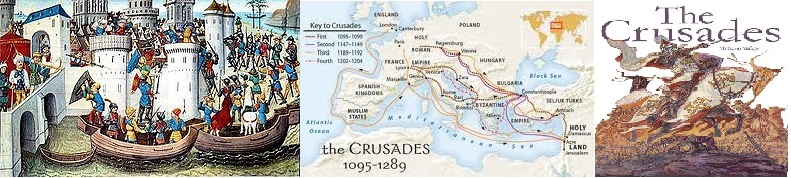
    The expansion of Islam and the Arab empire through the Seljuk Turks in the 11th century caused a note of distress to the clergy of Christianity. The conquest of areas in the Christian Byzantium empire helped to spur anger and resentment against Muslims. With an ever increasing population in the western world and the papal state’s need for power and territory the Crusades was the end result. There were a series of campaigns against Islam and against heretics and troublemakers in Europe itself.

    They were led by kings, princes, knights and papal legates as well as by shepherds and hermits. Frequently, they were under the control of the Church but in some instances they were not. The Church also offered many incentives to encourage men to take the Cross and conquer the Muslims. There were altogether seven crusades that were launched to conquer or regain land from the Arabs. However, while the Crusades began as a move to conquer the Muslims, they became a battle within the Christian faith itself. Many of the Europeans lost their values and religious beliefs and thus the Crusades became a time of re-identifying their faith.

    The First Crusade in 1096 was sprung from Pope Urban II’s sermon in 1095. This was the only crusade that the westerners successfully won. Future Crusades lacked disorganization and while many battles were won by the western world, the eventual outcome had the Arabs at the head. However, with thousands of dead from all faiths, Christianity, Islam, and Judaism, who was the real victor?

    The Eastern View

    "Regard the Franj! Behold with what obstinacy they fight for their religion, while we, the Muslims, show no enthusiasm for waging holy war."-Salah Al-Din.*

    To those of the Eastern world, the invasion of the Frankish people was not one of enlightenment. It was instead an attempt to conquer a land that was for centuries in the hands of eastern civilizations ranging from Arabs, Kurds, Armenians, and many more people of different ethnic descent. To the Muslims and the non-Muslims of the east, the Crusades was a war of a barbarous nature that needed to be repelled. It was a war against their faith and their customs. However, the decline of the Arab civilization soon after coming out victorious in the Crusades suggests that there were deeper issues in the conflict between the west and east. While the Crusades opened up new horizons and new trading areas for the west, the eastern world’s establishments began to decline and deteriorate and the lands they conquered became lost in the political power struggle between the Arabs.

    *Quote Taken From

    Maalouf, Amin. The Crusades Through Arab Eyes. Translated by Jon Rothschild, 1984. Al Saqi Books, 26 Wetbourne Grove, London W2.

    Add new comment
     
    • Home
    • The Crusades - Introduction
    • Chronology of Crusades
    • Sultan Salahuddin Ayubi
    • Tears of Salahuddin
    • Saladin by Amin Maalouf
    • Pope's Call
    • A Map - The Empire of Sultan Salah Al-Din
    • Arrival of the Franj
    • Jerusalem is Regained
    • Quotations on Jihad and Crusades
    • Crusader Atrocities
    Who's Online
    We have 4 guests online
    cd13.jpg
    Login Form


    • Forgot your password?
    • Forgot your username?
    • Create an account

    Copyright © 2010 The Sabr Foundation.
    All Rights Reserved.